




Best Strapping Machine Manufacturer in China?
Choosing the best strapping machine manufacturer in China requires more than comparing catalog prices. A dependable partner must understand production pressure, carton quality, operator habits, and after-sales realities. In a busy warehouse, cartons may arrive dusty, uneven, or slightly crushed. The machine must still position the strap accurately, maintain stable tension, and seal every joint consistently. Small failures become expensive quickly.
Packaging machinery consultant Michael J. Noonan once said, “A reliable strapping machine is not judged by speed alone; it is judged by stable tension, clean seals, and service after the sale.” This principle remains practical for buyers evaluating Chinese manufacturers. A strong supplier should explain whether the equipment uses polypropylene or polyester strap, how tension is adjusted, and how the sealing head handles continuous cycles. Ask for test videos using your actual carton sizes. Ask about spare parts, remote support, installation guidance, and response times.
The fastest machine is not always the best choice. Sometimes, a simpler model performs better because operators can maintain it without specialized tools. That detail is easy to overlook. A manufacturer with a modern factory, documented quality checks, experienced engineers, and export references offers stronger evidence than polished product photos. Still, no supplier is perfect. Testing should reveal weak points, including strap feeding, sensor alignment, noise, and performance during long shifts. The best decision balances machine speed, construction quality, service capability, and honest communication. Chinese manufacturing offers strong value, but careful verification remains necessary.
What Is a Strapping Machine and How Does It Work?
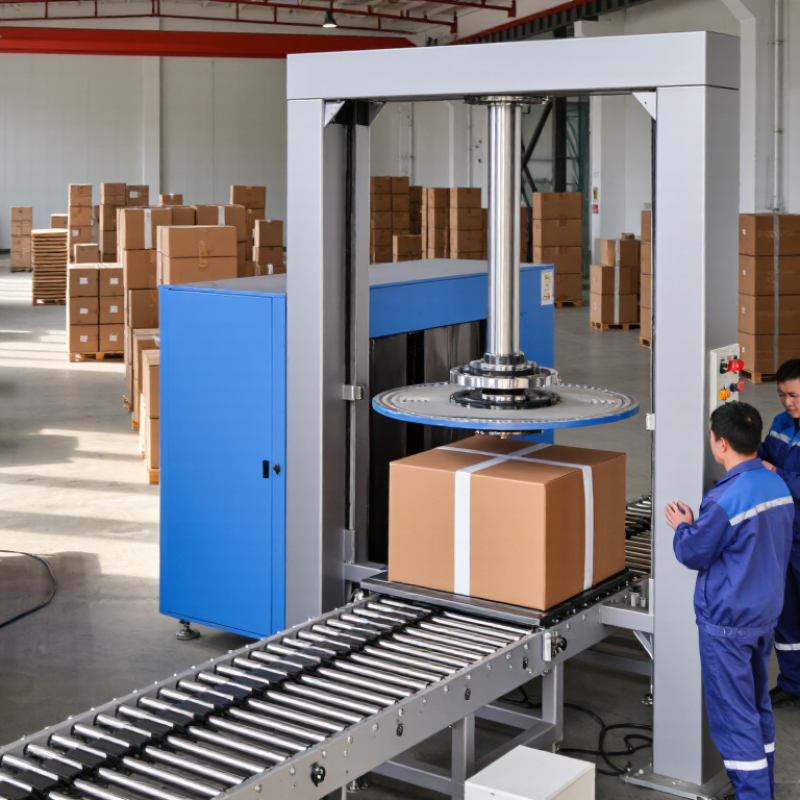
A strapping machine secures cartons, bundles, and pallet loads with consistent tension. It applies strap around a product, tightens it, seals the joint, and cuts the remaining material. Depending on the model, the machine may use polypropylene, polyester, or steel strap. Plastic strap suits many cartons, while heavier loads may require stronger material.
Picture a carton moving onto a conveyor. Sensors detect its position and activate the strap cycle. A feeding system guides the strap around the package. The tensioning unit pulls the strap firmly against the surface. A heat seal, friction weld, or metal seal then locks the joint. The cutter removes excess strap, and the machine resets for the next package. Some systems complete this cycle in only a few seconds.
Small details matter. A damp carton can reduce sealing quality. Incorrect strap width may cause feeding jams. Operators should check guides, tension settings, and sealing surfaces each shift. In practical production, many faults come from poor alignment rather than complex mechanical damage. Not every jam indicates a bad machine. Sometimes, the strap is stored badly or the package is uneven. A reliable manufacturer should explain these limits clearly, provide service records, and offer parts that match the working environment. A perfect setting rarely exists; testing with real cartons is still necessary.
| Machine Type | How It Works | Common Strap Materials | Typical Applications | What to Check When Choosing a Manufacturer |
|---|---|---|---|---|
| Semi-automatic tabletop | An operator wraps the strap around the load and inserts its end into the machine. The machine tensions the strap, joins it with a heat seal, and cuts off the excess. | Usually polypropylene (PP); compatibility depends on the machine. | Cartons, bundles, and other relatively small loads in lower-volume packing areas. | Confirm strap compatibility, adjustable tension, seal consistency, service access, and availability of replacement parts. |
| Automatic arch strapping machine | The machine feeds strap through an arch around the package, tensions it, seals the overlap, cuts the strap, and prepares for the next cycle. Conveyor integration can move packages into position automatically. | Commonly PP; some models also support PET, subject to the manufacturer's specifications. | Repeated strapping of cartons or bundles on packaging lines. | Check cycle requirements, package-size range, line integration, guarding, controls, and whether trials can be run with your actual loads. |
| Handheld battery-powered tool | The operator positions the tool on the strap. Depending on the model, it tensions, friction-welds or otherwise seals the overlap, and cuts the strap. | Often PP or PET; use only materials approved for the specific tool. | Mobile strapping and loads that are awkward to bring to a fixed machine, including some palletized goods. | Verify the approved strap range, battery and charger support, tool weight, seal quality, and operator training requirements. |
| Pallet strapping system | A lance or other feed mechanism guides strap around or beneath a pallet load. The system then tensions, joins, and cuts the strap; configuration varies by machine. | PET is commonly used for many pallet loads; steel strap is used for certain heavy-duty applications with compatible equipment. | Unitized pallet loads in distribution, manufacturing, and other material-handling operations. | Assess pallet dimensions, load stability, strap placement, required tension, safety features, and compatibility with upstream and downstream equipment. |
| Strapping machine basics | Most machines perform the same core sequence: feed strap around the load, apply tension, join the strap ends, cut the strap, and reset for the next cycle. The feeding and joining methods differ by machine type. | PP, PET, and steel are distinct strap materials; the correct choice depends on the load, handling conditions, and equipment compatibility. | Securing packages or loads for handling, storage, and transport. Strapping does not replace suitable packaging or load-stabilization practices. | Compare documented specifications, safety compliance, installation and training support, warranty terms, spare-parts availability, and service response—not price alone. |
Related Posts
-
2026 Best Semi Automatic Strapping Machine for Global Buyers?
-
How to Choose a Strapping Machine in 2026?
-
2026 Best Box Strapping Machine Reviews and Buying Guide?
-
Best Strapping Machine for Your Business Needs?
-
Essential Tips for Choosing the Best Automatic Banding Machine for Your Business
-
Semi Automatic Strapping Machine Tips for Optimal Performance?